.png?width=271&height=81&name=Knowledge%20base%20small%20(4).png)
Pension contribution methods determine how employee pension deductions are processed through payroll and how tax relief is applied.
The method used affects:
- Whether contributions are deducted before or after tax.
- How tax relief is provided.
- Whether National Insurance savings are available.
The system supports three common pension contribution methods:
| Pension Type | Pension Deducted From | Tax Relief | NI Saving |
| Relief at Source | Net pay (after tax) | Basic rate tax relief claimed by pension provider | No |
| Net Pay Arrangement | Gross pay (before tax) | Tax relief given through payroll | No |
| Salary Sacrifice | Salary reduced before payroll calculations | Tax relief achieved automatically through reduced salary | Yes |
How They Work
Relief at Source (RAS)
Pension contributions are deducted after tax has been calculated.
The employee pays 80% of the pension contribution and the pension provider claims the remaining 20% basic rate tax relief from HMRC. The full contribution is then paid into the pension scheme.
Net Pay Arrangement
Pension contributions are deducted before tax is calculated.
The employee receives tax relief immediately through payroll because tax is calculated on a lower taxable salary. The full pension contribution is deducted through payroll and paid into the pension scheme.
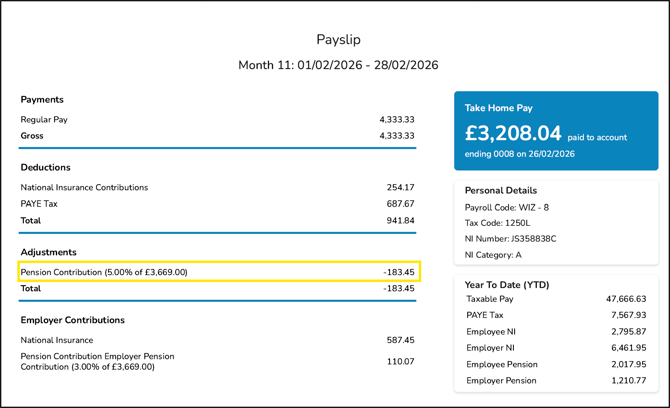
When pension contributions use RAS or Net Pay, the employees contribution will show as a deduction, as seen in the image above.
Salary Sacrifice
Salary Sacrifice works differently from both Relief at Source and Net Pay Arrangement.
Instead of making an employee pension contribution, the employee agrees to reduce their contractual salary. In return, the employer makes an equivalent pension contribution on their behalf.
Because the employee's salary is reduced before payroll calculations take place:
- Tax is calculated on a lower salary.
- National Insurance is calculated on a lower salary.
- The employee saves both tax and National Insurance.
- The employer also saves National Insurance and may choose to add some or all of that saving to the pension contribution.
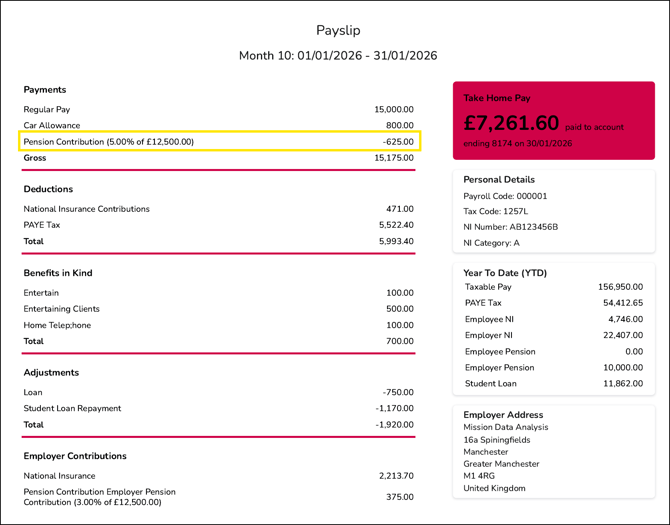
Where salary sacrifice is used, the pension shows in the payments section as seen in the image above.
Example
The following example shows how a £100 pension contribution is treated for an employee earning £2,000 per month.
Take Note 📝
A simple way to remember the differences is:
- Relief at Source: Tax relief comes from the pension provider.
- Net Pay Arrangement: Tax relief is provided through payroll.
- Salary Sacrifice: Tax relief and National Insurance savings are achieved because the employee's salary is reduced before payroll calculations are performed.